Focus on What will Save Your Life
In-depth firearms training with Cajun Arms, West Chester, PA
GET FIREARMS TRAINING THAT MATTERS
Students come to Cajun Arms from every walk of life. Some are brand new gun owners. Others have been shooting for decades. One trend we see consistently—especially in our Defensive Carry Level 1 classes—is that many students have spent years shooting paper bullseyes, but very little time training for realistic defensive encounters.
Hitting the center of a static circle is not the same as stopping a violent threat.
Early in our courses, we address this head-on: your eyes lead the fight, and the gun follows. You must first identify a threat before you can legally, morally, or tactically justify pointing a firearm at it.
Visual Focus Under Stress
Ideally, once a threat is identified, your visual focus shifts to your front sight while keeping both eyes open to reduce tunnel vision. In reality, under extreme stress, many people will remain visually locked onto the threat itself—and that’s human nature.
If your eyes stay on the threat, you must discipline where you are looking.
Focus on vital zones.
Ask yourself—consciously or subconsciously:
-
What is available?
-
What will stop the threat’s actions?
-
Where should my rounds go?
This is why we emphasize shot placement in detail during our defensive shooting courses. Center mass is often the primary target, but it is not always the effective target. Head and pelvic shots are taught for a reason—not as “Hollywood tactics,” but as problem-solving tools when other options fail.
The goal is not to “shoot.”
The goal is to make the bad guy stop doing bad things.
Threat Identification Is More Than Seeing a Gun
Target discrimination goes beyond simply identifying a weapon.
You must process:
-
Is the threat armed?
-
What type of weapon do they have?
-
Are they wearing body armor?
-
Are innocent people nearby?
-
What vital areas are exposed right now?
This is exactly why we teach pelvic shots in higher-level classes. A pelvic hit may not be immediately fatal, but it can be structurally devastating—dropping the threat to the ground and giving you, the good guy, a critical tactical advantage.
This level of decision-making does not come from casual range time. It comes from intentional practice and repetition.
Practice With Purpose—Not Just Paper
If you want your defensive shooting skills to hold up under stress, your practice must resemble reality.
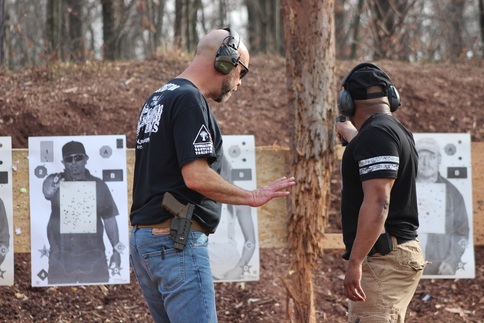
We strongly encourage using realistic human silhouette targets rather than blank paper or traditional bullseyes. Better yet, use targets that allow the object in the threat’s hand to be changed—a firearm, a knife, or something harmless like a cellphone or cup of coffee.
Here’s a simple but effective drill:
-
Work with a training partner
-
Turn your back to the target
-
Have them change the item in the target’s hand
-
On command, turn, identify, and decide whether deadly force is justified
To be clear:
-
A person holding a cup of coffee does not need holes in them
-
A person with a knife at 25 yards may not—yet
-
A person presenting an imminent deadly threat does
This exercise reinforces judgment, restraint, and accountability—core responsibilities of armed citizens.
Shoot What Matters
Ensure your rounds are going into vital zones. Think about it this way: in a hand-to-hand fight, you wouldn’t punch your opponent in the hand. Likewise, in a gunfight, you are not trying to shoot the weapon—you are stopping the person controlling it.
That level of discipline requires:
-
Repetition
-
Visualization
-
Scenario-based thinking
When you play the “what if” game—alone or with a like-minded training partner—visualization is just as important as live fire. The more scenarios you mentally and physically rehearse, the more prepared you will be if things go sideways.
Train for Reality With Cajun Arms
At Cajun Arms, our training is designed to prepare responsible gun owners for real-world defensive encounters—not just square-range performance.
If you’ve completed:
-
Defensive Carry 1
we strongly encourage continuing with:
-
Defensive Carry 2
Because skill fades. Complacency kills. And preparation saves lives.
Keep training. Focus on what matters. Train for what will save your life.
- How to Build a Personal Defensive Training Plan
- Why Qualification Scores Don't Measure Defensive Readiness
- The Hidden Costs of Cheap Firearms Training
- What Experienced Concealed Carriers Wish They Knew Earlier
- What Skills Matter Most in a Defensive Encounter?
- How Often Should You Train With Your Carry Gun?
- Why Most Gun Owners Plateau After Their First Training Class
- Why Serious Shooters Across Pennsylvania Train With Cajun Arms
- Why Training Matters More Than Gear
- Mistakes Intermediate Shooters Still Make