Grab a Partner
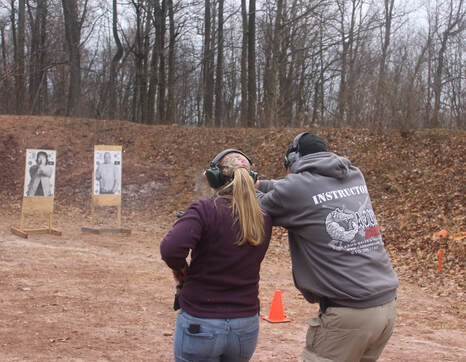
Benoit working during a private pistol lesson in West Chester, PA
Train Together: Why a Defense Partner Changes Everything
It takes two.
That’s something we’re seeing more and more at Cajun Arms.
Students aren’t just showing up alone anymore—they’re coming with:
- Spouses
- Parents or children
- Friends and roommates
- Coworkers
- Members of the same organization or team
At first glance, it makes sense. Having a familiar face in a class full of strangers is comforting.
But that’s not the real advantage.
The real advantage is this: you’re not just training—you’re building a team.
And in a defensive situation, that can change everything.
Why Training With a Partner Matters
Let’s start with a simple truth:
Two trained individuals working together are far more effective than two individuals acting independently.
That doesn’t happen automatically.
It requires:
- Shared understanding
- Consistent training
- Clear communication
- Defined roles
Without those elements, two people in a crisis can quickly become:
- Confused
- Disorganized
- Working against each other
With them, you become coordinated, efficient—and far more capable.
From Familiar Face to Defensive Partner
It’s one thing to attend a class together.
It’s another to train as a unit.
That shift requires intention.
Because when something goes wrong, you won’t have time to figure things out.
You’ll fall back on what you’ve already discussed and practiced.
Equal Training = Equal Capability
One of the biggest advantages you can create is parity.
You and your partner should be as close to equally trained as possible.
Why?
Because gaps create hesitation.
If one person is unsure:
- Decision-making slows down
- Communication breaks down
- Opportunities are missed
That doesn’t mean identical skill levels—but it does mean:
- Training together consistently
- Practicing the same fundamentals
- Understanding each other’s capabilities
You need to trust what the other person can do—without thinking about it.
The “What If” Game: Planning Before It Happens
Once you’re training together, the next step is planning.
And the simplest way to do that is:
Play the “what if” game.
Ask questions like:
- What if we’re separated?
- What if one of us is injured?
- What if the threat comes from behind?
- What if we’re in a confined space?
Then discuss:
- Who moves?
- Who engages?
- Who calls for help?
These conversations create a framework you can fall back on under stress.
Because here’s the reality:
It’s much easier to adapt a plan than to create one in the middle of chaos.
Communication: Simple, Clear, Effective
Once movement and coordination are introduced, communication becomes critical.
But here’s where many people overcomplicate things.
In a high-stress situation, you don’t have time for long conversations.
Simple communication wins.
We teach:
- Short
- Clear
- Predefined commands
Examples include:
- “Cover me”
- “In”
- “Clear”
- “Red”
The actual words don’t matter.
What matters is that both of you understand them—instantly and without hesitation.
Movement and Team Coordination
As you progress in training, things start to come together.
In our Level 2 and Level 3 classes, we introduce:
- Movement while shooting
- Working around and with another person
- Coordinating positions
- Communicating under pressure
This is where individuals begin to function as a unit.
And that’s where capability increases dramatically.
Real-World Considerations You Can’t Ignore
Now let’s talk about reality.
Because that’s what all of this is preparing you for.
H3: Who Becomes the Initial Target?
In many male/female partnerships, studies and real-world patterns suggest:
The male is often the initial focus of the attack.
That matters.
Because if one person is engaged immediately, the other must be ready to act.
Ladies—this is where your training takes over.
You may need to:
- Assess the situation instantly
- Move decisively
- Go on the offensive if necessary
Preparation makes that possible.
Vehicle-Based Threats (Carjackings)
Carjackings are another critical scenario.
They often:
- Happen quickly
- Occur at close range
- Originate from the driver’s side
So ask yourself:
What’s your plan if both of you are in the vehicle—and both are armed?
Who engages?
Who moves?
What angles are safe?
These are not decisions you want to make for the first time in the moment.
We introduce and work through these scenarios in our Level 2 classes.
Equipment Compatibility Matters
Another often-overlooked factor is your gear.
Can you run your partner’s firearm if you had to?
Ideally:
- You carry similar platforms
- You share magazine compatibility
A great example:
- Glock 17 and Glock 19
- Shared magazines
- Familiar controls
If that’s not the case:
- Train with each other’s firearms
- Understand how they operate
- Be able to run them confidently
Because in a real situation, your partner’s firearm may be the closest tool available.
Train Together, Build Confidence Together
Training as a team doesn’t just build skill—it builds confidence.
You begin to:
- Understand each other’s tendencies
- Communicate more efficiently
- React faster under pressure
And most importantly:
You stop being two individuals—and start becoming one coordinated force.
Don’t Wait to Figure It Out Later
Here’s the bottom line:
If you plan to defend yourself with someone else present—
- A spouse
- A friend
- A coworker
- A team member
Then you need to train together.
Because in a real encounter:
Confusion is dangerous. Coordination is powerful.
Ready to Train as a Team?
This is where you take the next step.
You can continue training individually…
Or you can build a real defensive partnership.
Start Today
👉 Sign up for a class together now — train side-by-side and build real-world skills
👉 Book a private partner session for focused, team-based coaching
👉 Contact Cajun Arms today to create a training plan for you and your partner
Spots fill quickly—especially for partner training. Don’t wait.
Train together. Communicate better. Perform under pressure.
We’ll see you both on the range.
Question:
Should you train for self defense with a partner?
Answer:
Yes, training for self-defense with a partner improves communication, coordination, and overall effectiveness. Practicing together helps both individuals understand roles, respond faster, and perform better under stress.
- How to Build a Personal Defensive Training Plan
- Why Qualification Scores Don't Measure Defensive Readiness
- The Hidden Costs of Cheap Firearms Training
- What Experienced Concealed Carriers Wish They Knew Earlier
- What Skills Matter Most in a Defensive Encounter?
- How Often Should You Train With Your Carry Gun?
- Why Most Gun Owners Plateau After Their First Training Class
- Why Serious Shooters Across Pennsylvania Train With Cajun Arms
- Why Training Matters More Than Gear
- Mistakes Intermediate Shooters Still Make