Point Shooting: Does it work?
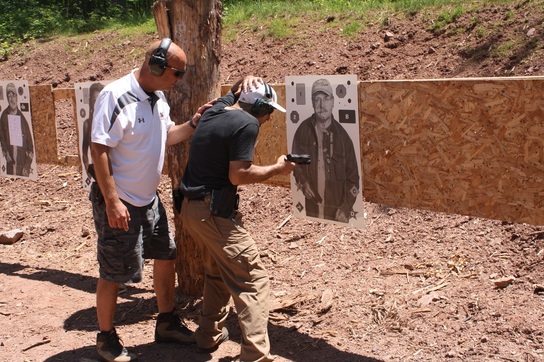
Firearms train with Cajun Arms, West Chester, PA
Understanding One of the Most Misunderstood Concepts in Defensive Shooting
Few topics in defensive firearms training generate more confusion than point shooting.
Ask ten shooters what point shooting is and you'll likely get ten different answers.
Some believe it means firing from the hip.
Others think it means shooting without using sights.
Some assume it's simply shooting quickly.
The reality is that many shooters who claim to be point shooting are actually using a form of aimed fire without realizing it.
So let's clear up the confusion.
What Is Point Shooting?
True point shooting is firing a handgun without consciously using the sights to align the firearm with the target.
Instead, the shooter relies on body positioning, hand-eye coordination, and repetition to direct the firearm toward the intended target.
Think about pointing your finger at an object.
You don't consciously align sights.
You simply point.
True point shooting attempts to accomplish the same thing with a handgun.
While this technique exists, it is often misunderstood and frequently overestimated.
The Biggest Mistake Shooters Make
One of the most common training mistakes occurs when shooters believe they can simply point the firearm in the general direction of a threat and "walk" rounds onto the target.
This is not a sound defensive shooting strategy.
If your training consists of firing rounds and adjusting based on where previous shots landed, you are relying on luck rather than skill.
Defensive shootings happen quickly.
There may not be time for corrective shots.
There may be innocent people nearby.
And remember:
You are accountable for every round that leaves your firearm.
The goal should be accurate hits as quickly as possible—not using misses to find the target.
Why We Teach Sighted Fire First
There is a reason defensive firearms instructors spend so much time discussing sight alignment and sight picture.
Those skills work.
Before any advanced shooting technique can be explored, shooters should first develop proficiency with traditional sighted fire.
At Cajun Arms, students are taught to build a strong foundation using proper sight alignment, trigger control, and presentation techniques before exploring more advanced concepts.
The fundamentals are not exciting.
They are effective.
And effectiveness matters more than novelty.
What Most Shooters Call Point Shooting Isn't Actually Point Shooting
Here's where things get interesting.
Many shooters believe they are point shooting when they bring the pistol into their line of sight and superimpose the slide, optic window, or general outline of the firearm onto the target.
That isn't true point shooting.
It's actually a form of aimed fire.
You may not be focusing sharply on the front sight.
You may not even consciously register the sights.
But you're still using visual information from the firearm to align your shot.
That's a very different process than simply pointing the gun and firing.
And it's generally a much more effective one.
Threat-Focused Shooting Has Some Merit
Under extreme stress, most people naturally focus on the threat.
This is normal human behavior.
In fact, many individuals involved in defensive shootings later report that they cannot remember whether they consciously saw their sights at all.
The eyes naturally want to focus on danger.
Because of this, threat-focused shooting techniques do have some practical value.
However, there is a significant difference between being threat-focused and completely ignoring your sights.
The best shooters learn to maintain awareness of the threat while still using visual references from the firearm when necessary.
The faster and more experienced the shooter becomes, the less visual confirmation is typically required.
Don't Confuse Point Shooting With Contact Shooting
Another common misunderstanding involves contact shooting.
Contact shooting occurs at extremely close distances where the firearm is positioned directly against or very near the attacker.
At these distances, traditional sight alignment becomes largely irrelevant because the muzzle is already directed into the threat.
This is not point shooting.
It is a specialized close-quarters technique that presents its own challenges.
For example:
- Out-of-battery malfunctions
- Weapon retention concerns
- Muzzle placement issues
- Physical entanglement with the attacker
These skills require dedicated training and should not be practiced casually.
What About Index Shooting?
Index shooting is another technique that often gets grouped under the point shooting umbrella.
In this method, the shooter uses a consistent presentation and body position to align the firearm without relying heavily on the sights.
The challenge is that index shooting often depends on specific distances, body mechanics, and conditions.
Change the distance.
Change the angle.
Change the position.
The results can change dramatically.
This is one reason we generally recommend developing strong sighted-fire fundamentals first.
A skill that only works under ideal conditions is not a skill you should rely upon.
What the Best Defensive Shooters Actually Do
Watch highly skilled defensive shooters and you may think they're point shooting.
They're usually not.
They're simply aiming very quickly.
Instead of obtaining a perfect sight picture, they use what is often called a flash sight picture.
The sights appear briefly.
The shooter confirms what is needed.
The shot breaks.
At typical defensive distances, the goal is not tiny groups or perfect bullseye accuracy.
The goal is effective hits delivered rapidly.
A fist-sized group at seven yards is generally more than sufficient for defensive purposes.
This is coarse aiming, not precision shooting.
And it works.
Red Dots Have Changed the Conversation
The increasing popularity of pistol-mounted red dots has created new opportunities—and new misconceptions.
Many shooters discover they can acquire the dot extremely quickly while maintaining focus on the threat.
In some ways, this feels similar to point shooting.
But it isn't.
The shooter is still using an aiming reference.
The difference is that the aiming reference is projected onto a single focal plane rather than requiring traditional front sight focus.
For many shooters, red dots offer significant advantages:
- Faster target acquisition
- Improved precision
- Better performance at distance
- Easier shooting in low light
However, success with red dots still requires training and proper presentation.
One common technique is to acquire the backup iron sights briefly during presentation. When the pistol is aligned correctly, the dot naturally appears in the optic window.
Practice the Fundamentals
If you struggle to see your sights quickly, the answer is usually not abandoning your sights.
The answer is practice.
Dry-fire training remains one of the best ways to improve:
- Sight acquisition
- Presentation
- Trigger control
- Target transitions
- Red dot tracking
For more on building effective habits, read our article Program Your Brain: Why Perfect Practice Beats Fast Practice.
You may also find these articles helpful:
How Often Should You Train With Your Carry Gun?
What Skills Matter Most in a Defensive Encounter?
So, Does Point Shooting Work?
The answer is yes—but probably not in the way most people think.
True point shooting is a highly advanced skill that requires extensive repetition, exceptional hand-eye coordination, and a deep familiarity with the firearm.
Most shooters would be better served by developing strong fundamentals, learning to acquire their sights quickly, and mastering efficient presentations.
In reality, what many people call point shooting is simply very fast aimed fire.
And that's a good thing.
The goal isn't to ignore your sights.
The goal is to become so proficient with them that using them becomes nearly automatic.
Final Thoughts
Defensive shooting is about solving problems, not demonstrating tricks.
While point shooting has a place in the discussion, it should never replace solid marksmanship fundamentals.
The most capable shooters are not the ones who ignore their sights.
They're the ones who have practiced enough that sighted fire becomes fast, efficient, and reliable under stress.
At Cajun Arms, we focus on building practical defensive skills that work in the real world—not just on the square range. Whether you're learning the fundamentals or refining advanced techniques, every skill begins with a solid foundation.
- How to Build a Personal Defensive Training Plan
- Why Qualification Scores Don't Measure Defensive Readiness
- The Hidden Costs of Cheap Firearms Training
- What Experienced Concealed Carriers Wish They Knew Earlier
- What Skills Matter Most in a Defensive Encounter?
- How Often Should You Train With Your Carry Gun?
- Why Most Gun Owners Plateau After Their First Training Class
- Why Serious Shooters Across Pennsylvania Train With Cajun Arms
- Why Training Matters More Than Gear
- Mistakes Intermediate Shooters Still Make
- Dry Fire Training: What Actually Works vs. What’s a Waste of Time
- Top 10 Mistakes New Concealed Carriers Make (And How to Avoid Them)
- Why Are You Just Standing There? Shooting From Unconventional Positions
- You Get What You Pay For: Why Quality Firearms Training Matters
- How to Choose a Firearms Training Class in Pennsylvania (2026 Guide)
- Teaching Your Child Gun Safety: A Parent's Complete Guide
- AR15 for Home Defense: Choosing the Right Gun for the Job
- Understanding Self-Defense Laws and Concealed Carry in Pennsylvania: A Comprehensive Overview
- Low-Light Defensive Shooting: Techniques You Won’t Learn on the Square Range
- Defensive Mindset: How to Stay Calm and Think Under Stress
- Why De-Escalation Training Completes a Well-Rounded Defensive Education
- Self Defense Training for Your Family in Uncertain Times
- How Often Should You Train With Your Concealed Carry Firearm?
- Where to Sell Used Firearms: Why Cajun Arms is Your Premier PA Choice
- Why Training Outdoors in Winter Matters More Than You Think
- Why Most Gun Owners Fail Under Stress — And How Stress-Inoculation Training Fixes It
- Avoidance and Awareness: Your First Line of Self-Defense
- Mental Preparation for Defensive Shooting Class
- Mental Preparation for Defensive Shooting: The Missing Link for CCW Holders
- 2025/26 Trends in CCW & Concealed Carry: What Every Responsible Gun Owner Should Know
- Mastering Speed and Precision in Defensive Pistol Training: A Complete Guide
- Why Small Unit Tactics (SUT) Don’t Work for Civilians — And What Does: A Cajun Arms Guide
- What to Expect in a Defensive Pistol Class
- Essential AR15 Maintenance Tips for Maximum Reliability and Long Service Life
- Bad Guys Come Out in the Heat
- Looking for “Firearms Training Near Me”? Here’s What to Expect—and How to Choose the Right Instructor
- Speed vs. Precision: What Matters Most in a Defensive Shooting?
- Dynamic Movement & Shooting: Train Like You Fight
- Firearms Training and Home Defense
- From Basics to Advanced: Tactical Shooting Courses at Cajun Arms
- Firearms Training Near Me - Cajun Arms West Chester, PA
- Master Your AR-15 with Expert Training at Cajun Arms
- Defensive Pistol Training for Self-Defense — Cajun Arms
- Choose the Best Home Defense Firearm — Cajun Arms Guidance
- Becoming a Firearms Instructor: The Path to Excellence
- Empowerment Through Precision: Elevating Your Self-Defense Firearm Skills
- Training Scars: Breaking Free From Flat-Range Habits
- Vehicle Defense
- WATCH WHAT YOU FEED YOUR GUN
- CAN YOU BE ACCOUNTABLE FOR YOUR SPEED?
- Training with Micro-Compacts
- A Follow Up to the “Hardest Shooting Fundamental”
- So You Want To Go Fast?
- The Hardest Shooting Fundamental: Mastering Follow-Through
- New Gun, New Habits
- Home Defense Shotgun Set Up
- What Should I be Doing at the Range?
- Fighting From The Ground
- Take Charge of Recoil, don’t let it control you…
- Think Before You Speak
- Grab a Partner
- The Risks of Being Nice
- Lead With Your Eyes (not your muzzle)
- Train as You Carry… Leave the competition and tactical gear behind
- KNIFE VS GUN - A quick scenario to ponder
- Frankengun vs. Factory: Choosing a Reliable AR for Self-Defense
- Program Your Brain: Why Perfect Practice Beats Fast Practice
- What If You're Injured During a Defensive Encounter?
- Lights and Lasers and YouTube Ninjas
- Our Stance on Your Stance
- Training for More Than One Attacker…
- Keep Your Head On - Consistency
- Defensive Shotgun Accessories: What You Need—and What You Don't
- Charlottesville - lies and hypocrites
- Keep Your Finger Off the Trigger…
- …and Re-holster
- Unauthorized persons…
- Focus on What will Save Your Life
- Train for Success with your Firearms
- Every Day is a Good Day to Be Ready
- Appendix Carry - Is it right for you?
- Learn to See the Light: Low-Light Firearms Training You Can Use
- Anti-Gun Sentiment on the Internet: How It Affects Lawful Firearms Owners
- Point Shooting: Does it work?
- About your self-defense carry ammo...
- See the Whole Picture... Know how to reload reflexively
- One-Handed Shooting
- Every Bullet Has a Price
- On Magazine Changes... fighting for your life
- There is Such a Thing as Too Fast...
- A Threat at Arm's Length
- In Defensive Shooting, Missing Your Target Has Consequences...
- Operating out of your Comfort Zone...
- Every Bullet Has A Price - Operational Speed
- Car and Truck Gun Safety: Protect Yourself Responsibly
- Keep a Clear Head
- Get Training!
- Women and Firearms at Cajun Arms