Program Your Brain: Why Perfect Practice Beats Fast Practice
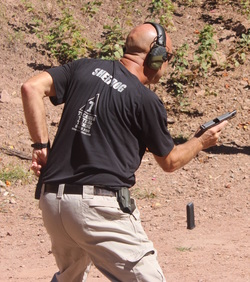
Pistol skills with Jim Benoit, Cajun Arms, West Chester, PA
Memory, Repetition, and Defensive Firearms Training
Have you ever watched a top-level competition shooter perform a reload so quickly that you barely saw it happen?
The magazine seems to appear in the gun by magic.
The reload is smooth.
Efficient.
Effortless.
Naturally, many shooters assume the secret is speed.
It isn't.
The secret is repetition.
More specifically, it's correct repetition.
The shooter who appears lightning-fast isn't trying to move fast. They're performing a sequence of movements that has been practiced so many times that it no longer requires conscious thought.
The body simply executes the program.
And that's exactly what should happen when you're carrying a firearm for self-defense.
The Problem With Practicing Fast
One of the biggest mistakes shooters make is attempting to perform every drill at maximum speed.
The result is usually predictable:
- Fumbled reloads
- Missed magazine wells
- Poor grip acquisition
- Incomplete manipulations
- Missed shots
- Equipment-induced malfunctions
Many shooters can perform these tasks successfully while standing still under ideal conditions.
Add movement.
Add decision-making.
Add stress.
Add uncertainty.
Suddenly, everything begins to fall apart.
The reason is simple.
They programmed speed before they programmed consistency.
Stress Exposes Weaknesses
One of the most interesting things we observe during training is how quickly seemingly solid skills can deteriorate under pressure.
A student may execute a perfect reload repeatedly during practice.
Then a timer appears.
Movement is introduced.
A problem must be solved.
Suddenly the reload is missed.
The magazine is dropped.
The shooter short-strokes the slide.
Or a malfunction appears because the firearm wasn't manipulated correctly.
Stress has a remarkable ability to expose weaknesses in technique.
This is one reason quality training focuses on developing reliable skills rather than simply chasing faster times.
If you've read our article What Skills Matter Most in a Defensive Encounter?, you'll remember that decision-making and emotional control often matter more than raw speed.
Smooth Is Fast
You've probably heard the phrase:
"Slow is smooth. Smooth is fast."
Like many clichés, it survives because it's true.
A smooth reload is efficient.
A smooth draw is efficient.
A smooth trigger press is efficient.
When movements become smooth, unnecessary motion disappears.
The shooter stops fighting the firearm and begins working with it.
Speed naturally emerges as a byproduct of efficiency.
Trying to force speed before developing consistency usually produces the opposite result.
Train the Correct Sequence
Consider a reload.
Your goal should not be to move as quickly as possible.
Your goal should be to perform the sequence correctly every single time.
The firearm comes into the workspace.
The magazine is released.
The support hand retrieves the fresh magazine.
The magazine is indexed properly.
The firearm is rotated to present the magazine well.
The magazine is inserted and seated.
The firearm is returned to operation.
Each step should occur deliberately and correctly.
Then it should be repeated.
Again.
And again.
And again.
Eventually the sequence becomes automatic.
Your Brain Is Building Software
Think of every repetition as writing code into your brain.
Each correct repetition strengthens the program.
Each incorrect repetition strengthens bad habits.
Unfortunately, your brain doesn't distinguish between good practice and bad practice.
It simply records whatever you repeat.
This is why practicing mistakes can be so dangerous.
The old saying is worth remembering:
Practice does not make perfect. Practice makes permanent.
If you repeatedly perform a skill incorrectly, that flawed version becomes your default response under stress.
What Happens Under Stress?
When a defensive encounter occurs, your body experiences physiological changes that can dramatically affect performance.
Fine motor skills deteriorate.
Heart rate increases.
Vision narrows.
Decision-making becomes more difficult.
This is not the ideal time to consciously think through a complex sequence of actions.
The skills that survive stress are the skills that have been deeply ingrained through repetition.
The reload.
The draw.
The presentation.
The trigger press.
All of these should happen with minimal conscious thought.
This is why defensive shooters should focus on programming reliable habits rather than chasing impressive range performance.
Dry Fire Is the Perfect Programming Tool
One of the most effective ways to build reliable skills is through structured dry-fire practice.
Dry fire allows shooters to perform large numbers of correct repetitions without ammunition costs or range limitations.
Skills that benefit greatly from dry fire include:
- Draw stroke
- Reloads
- Trigger control
- Sight acquisition
- Malfunction clearances
- Movement mechanics
The key is maintaining quality.
Ten perfect repetitions are more valuable than one hundred sloppy ones.
For more on building an effective practice routine, read our article How Often Should You Train With Your Carry Gun?
Why Defensive Training Is Different
Competition shooting and defensive shooting often overlap, but they are not identical.
Competition rewards speed and efficiency within a known environment.
Defensive encounters involve uncertainty, stress, movement, obstacles, and decision-making.
The objective isn't to win a trophy.
The objective is to solve a problem and go home safely.
That means reliability matters more than raw speed.
A slightly slower reload that works every time is far more valuable than a lightning-fast reload that fails under pressure.
Repetition Creates Confidence
Confidence doesn't come from telling yourself you're prepared.
Confidence comes from demonstrated competence.
Every correct repetition builds trust in your abilities.
Every successful practice session reinforces your skill set.
Over time, those repetitions become deeply ingrained.
The firearm begins to feel like a familiar tool rather than a complicated machine.
That's when performance starts to become resilient under stress.
If you've ever wondered why some shooters stop improving despite years of experience, our article Why Most Gun Owners Plateau After Their First Training Class explains how poor practice habits can stall progress.
Train Your Brain First
Many shooters spend thousands of dollars upgrading their firearms.
Far fewer spend time improving the software running the system.
The software is your brain.
The habits you build.
The movements you repeat.
The decisions you practice.
These are the things that determine how you will perform when it matters most.
The firearm is merely the tool.
You are the weapon system.
Final Thoughts
The fastest shooters are rarely the shooters who tried to become fast.
They're the shooters who spent countless hours performing skills correctly.
Speed emerged naturally from consistency.
If your goal is defensive preparedness rather than trophies, focus on building reliable habits.
Perform skills correctly.
Repeat them often.
Program your brain for success.
At Cajun Arms, we emphasize skill development that holds up under pressure—not just on the practice range. Through structured training, dry-fire practice, and deliberate repetition, students learn to build habits that remain reliable when stress enters the equation.
Continue Learning
- How to Build a Personal Defensive Training Plan
- Why Qualification Scores Don't Measure Defensive Readiness
- The Hidden Costs of Cheap Firearms Training
- What Experienced Concealed Carriers Wish They Knew Earlier
- What Skills Matter Most in a Defensive Encounter?
- How Often Should You Train With Your Carry Gun?
- Why Most Gun Owners Plateau After Their First Training Class
- Why Serious Shooters Across Pennsylvania Train With Cajun Arms
- Why Training Matters More Than Gear
- Mistakes Intermediate Shooters Still Make
- Dry Fire Training: What Actually Works vs. What’s a Waste of Time
- Top 10 Mistakes New Concealed Carriers Make (And How to Avoid Them)
- Why Are You Just Standing There? Shooting From Unconventional Positions
- You Get What You Pay For: Why Quality Firearms Training Matters
- How to Choose a Firearms Training Class in Pennsylvania (2026 Guide)
- Teaching Your Child Gun Safety: A Parent's Complete Guide
- AR15 for Home Defense: Choosing the Right Gun for the Job
- Understanding Self-Defense Laws and Concealed Carry in Pennsylvania: A Comprehensive Overview
- Low-Light Defensive Shooting: Techniques You Won’t Learn on the Square Range
- Defensive Mindset: How to Stay Calm and Think Under Stress
- Why De-Escalation Training Completes a Well-Rounded Defensive Education
- Self Defense Training for Your Family in Uncertain Times
- How Often Should You Train With Your Concealed Carry Firearm?
- Where to Sell Used Firearms: Why Cajun Arms is Your Premier PA Choice
- Why Training Outdoors in Winter Matters More Than You Think
- Why Most Gun Owners Fail Under Stress — And How Stress-Inoculation Training Fixes It
- Avoidance and Awareness: Your First Line of Self-Defense
- Mental Preparation for Defensive Shooting Class
- Mental Preparation for Defensive Shooting: The Missing Link for CCW Holders
- 2025/26 Trends in CCW & Concealed Carry: What Every Responsible Gun Owner Should Know
- Mastering Speed and Precision in Defensive Pistol Training: A Complete Guide
- Why Small Unit Tactics (SUT) Don’t Work for Civilians — And What Does: A Cajun Arms Guide
- What to Expect in a Defensive Pistol Class
- Essential AR15 Maintenance Tips for Maximum Reliability and Long Service Life
- Bad Guys Come Out in the Heat
- Looking for “Firearms Training Near Me”? Here’s What to Expect—and How to Choose the Right Instructor
- Speed vs. Precision: What Matters Most in a Defensive Shooting?
- Dynamic Movement & Shooting: Train Like You Fight
- Firearms Training and Home Defense
- From Basics to Advanced: Tactical Shooting Courses at Cajun Arms
- Firearms Training Near Me - Cajun Arms West Chester, PA
- Master Your AR-15 with Expert Training at Cajun Arms
- Defensive Pistol Training for Self-Defense — Cajun Arms
- Choose the Best Home Defense Firearm — Cajun Arms Guidance
- Becoming a Firearms Instructor: The Path to Excellence
- Empowerment Through Precision: Elevating Your Self-Defense Firearm Skills
- Training Scars: Breaking Free From Flat-Range Habits
- Vehicle Defense
- WATCH WHAT YOU FEED YOUR GUN
- CAN YOU BE ACCOUNTABLE FOR YOUR SPEED?
- Training with Micro-Compacts
- A Follow Up to the “Hardest Shooting Fundamental”
- So You Want To Go Fast?
- The Hardest Shooting Fundamental: Mastering Follow-Through
- New Gun, New Habits
- Home Defense Shotgun Set Up
- What Should I be Doing at the Range?
- Fighting From The Ground
- Take Charge of Recoil, don’t let it control you…
- Think Before You Speak
- Grab a Partner
- The Risks of Being Nice
- Lead With Your Eyes (not your muzzle)
- Train as You Carry… Leave the competition and tactical gear behind
- KNIFE VS GUN - A quick scenario to ponder
- Frankengun vs. Factory: Choosing a Reliable AR for Self-Defense
- Program Your Brain: Why Perfect Practice Beats Fast Practice
- What If You're Injured During a Defensive Encounter?
- Lights and Lasers and YouTube Ninjas
- Our Stance on Your Stance
- Training for More Than One Attacker…
- Keep Your Head On - Consistency
- Defensive Shotgun Accessories: What You Need—and What You Don't
- Charlottesville - lies and hypocrites
- Keep Your Finger Off the Trigger…
- …and Re-holster
- Unauthorized persons…
- Focus on What will Save Your Life
- Train for Success with your Firearms
- Every Day is a Good Day to Be Ready
- Appendix Carry - Is it right for you?
- Learn to See the Light: Low-Light Firearms Training You Can Use
- Anti-Gun Sentiment on the Internet: How It Affects Lawful Firearms Owners
- Point Shooting: Does it work?
- About your self-defense carry ammo...
- See the Whole Picture... Know how to reload reflexively
- One-Handed Shooting
- Every Bullet Has a Price
- On Magazine Changes... fighting for your life
- There is Such a Thing as Too Fast...
- A Threat at Arm's Length
- In Defensive Shooting, Missing Your Target Has Consequences...
- Operating out of your Comfort Zone...
- Every Bullet Has A Price - Operational Speed
- Car and Truck Gun Safety: Protect Yourself Responsibly
- Keep a Clear Head
- Get Training!
- Women and Firearms at Cajun Arms